

Agencies understand disruption.
New channels. New platforms. New tools. New client expectations. For those of us who work, or have worked, in agencies, we feel it. We’ve adapted again and again, often faster than our clients.
But artificial intelligence is different.
AI isn’t just another capability to layer into your tech stack or a way to shave time off existing workflows. It’s a force reshaping how value is created across industries, roles, and especially professional services.
Right now, many agencies are using AI to work faster. That’s a smart place to start. But it’s not where the story ends.
Because the agencies that will win in the next decade won’t just use AI to optimize what already exists. They’ll use it to reimagine what’s possible.
Why AI Optimization Is Only the First Chapter
Most organizations approach AI through a familiar lens:
- Automate workflows
- Reduce costs
- Increase productivity
These gains are real. And necessary.
But they’re also temporary.
When everyone has access to similar AI tools, efficiency becomes less of a differentiator. Speed becomes baseline. Cost savings equalize. For agencies, this raises a much bigger question:
If AI can help speed up and reduce the cost of the services we sell, what, exactly, are we selling next?
This is where the conversation needs to shift from optimization to innovation.
From Doing the Same Work Faster to Creating New Value
AI is already reshaping how organizations:
- Communicate and sell
- Design products and services
- Hire, train, and develop talent
- Build strategy and allocate resources
For agencies, this opens the door to entirely new possibilities:
- New service lines powered by AI
- AI-enabled client experiences
- Proprietary tools, platforms, or IP
- New pricing models and revenue streams
AI isn’t just a way to improve margins; it’s a way to expand the role agencies play in their clients’ growth.
But reaching this potential requires more than experimentation with tools. It requires leadership, intentionality, and a clear framework for innovation.
What Agency Leaders Should Be Asking Right Now
At this moment, agency leaders are navigating a mix of excitement and uncertainty.
You may be asking:
- Where should (and shouldn’t) we actually invest in AI?
- How do we avoid chasing every new tool while still moving fast enough?
- What skills will our teams need 12, 24, 36 months from now?
- How do we innovate responsibly, without putting our clients or our people at risk?
These are leadership questions. Not technical ones.
And they’re exactly the questions Paul Roetzer addresses in his upcoming keynote at the AI for Agencies Summit.
A Framework for AI-Driven Agency Growth
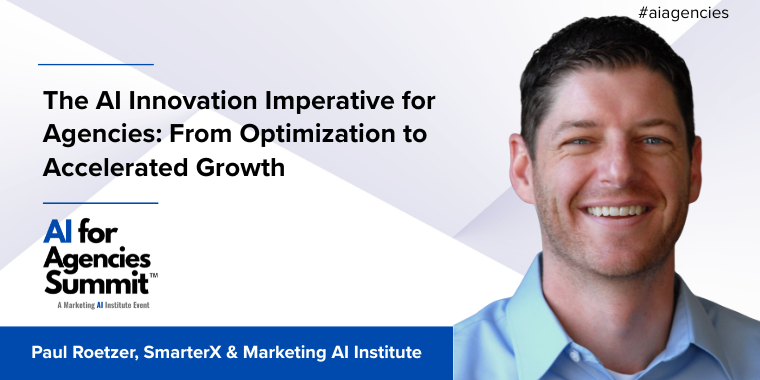
In his session, “The AI Innovation Imperative for Agencies: From Optimization to Accelerated Growth,” Paul delivers an executive-level view of where AI is headed and what it means for agencies specifically.
Drawing on his experience as both an agency founder and AI educator, Paul will walk through how agency leaders can:
- Identify and prioritize AI-driven innovation opportunities across services, operations, and go-to-market strategies
- Interpret key AI trends shaping the near-term future and understand which ones actually matter
- Build the conditions for AI-powered innovation, including:
- Talent and skills development
- Governance and ethical guardrails
- Experimentation and execution at scale
The goal isn’t to chase the latest tools. It’s to build an AI-forward agency, one that can adapt faster, innovate smarter, and create new value for clients.
Why This Matters Now
AI capabilities are advancing at an extraordinary pace. The window for experimentation is closing, and the era of execution is beginning.
Agencies that treat AI as a side project risk falling behind. Agencies that treat it as a core strategic capability stand to redefine their future.
As Paul said in a recent LinkedIn post:
“Many marketing agencies are at a crossroads. AI is threatening to disrupt traditional service and pricing models, while presenting new growth opportunities for the firms that can reimagine their business and help clients drive AI transformation.”
That’s not fear-mongering. It’s a call to leadership.
Join the Conversation at the AI for Agencies Summit
Paul Roetzer will deliver this keynote at the AI for Agencies Summit, a free, virtual event designed for agency leaders and practitioners who want to move beyond experimentation and toward real, sustainable growth.
- February 12
- Free registration
- Virtual
Register for the AI for Agencies Summit
The questions raised in this session are ones every agency leader should be thinking about right now.
Learn More from Paul
Listen to Paul and Mike and subscribe to The Artificial Intelligence Show podcast.
Hear Paul’s 2025 MAICON Opening Keynote
About Paul Roetzer
Paul Roetzer is the Founder & CEO of SmarterX and Marketing AI Institute, where he leads efforts to accelerate AI literacy and human-centered AI transformation in organizations.
He is the co-author of Marketing Artificial Intelligence, creator of the Marketing AI Conference (MAICON), and co-host of the popular podcast The Artificial Intelligence Show. Through SmarterX’s AI Academy, Paul has helped tens of thousands of professionals learn how to apply AI responsibly and strategically.
Before founding Marketing AI Institute, Paul launched PR 20/20—HubSpot’s first partner agency—which he sold in 2021 after establishing it as a pioneer in digital marketing.
This unique combination of agency experience and AI leadership gives Paul a pragmatic, story-driven approach to helping organizations rethink business models, reinvent industries, and build for what’s next.
About the AI for Agencies Summit
The AI for Agencies Summit brings together agency leaders and practitioners to explore how AI is reshaping agency models, services, and growth.
Do you want to hear from Paul and five other agency leaders? Register for the free, virtual AI for Agencies Summit 2026, taking place Feb. 12, 2026.

Cathy McPhillips
Cathy McPhillips is the Chief Marketing Officer at SmarterX and Marketing AI Institute